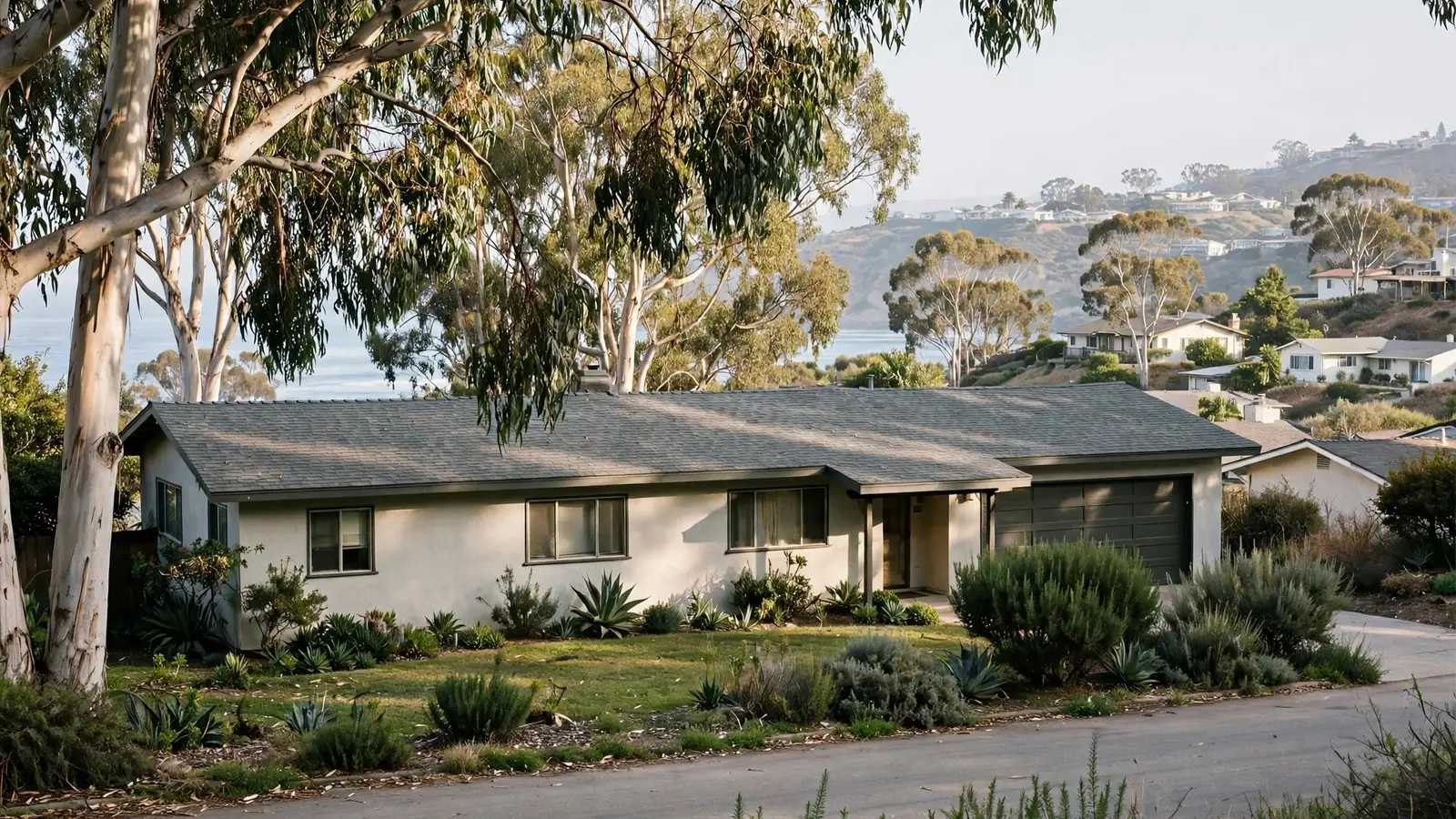
Key facts: Del Mar Heights
- Del Mar Heights is a neighborhood of the City of San Diego that shares the 92014 ZIP code with the City of Del Mar.
- Much of Del Mar Heights was developed with single-family homes in the 1960s and 1970s.
- Homes built on concrete slabs can develop slab leaks where water pipes run under or through the slab.
- Homes built before 1978 may contain lead-based paint, and work that disturbs it is covered by EPA's Renovation, Repair and Painting rule.
Covered area
Del Mar Heights streets covered by this line
Calls from Del Mar Heights homes in ZIP 92014 can be connected to an independent restoration contractor.
- 92014Del Mar Heights in the City of San Diego, on the mesa south and east of the City of Del Mar, between Interstate 5, Torrey Pines and the Crest Canyon area.
About Del Mar Heights
What sets Del Mar Heights homes apart
Del Mar Heights sits on the high ground above the city of Del Mar, inside the City of San Diego. Its streets are lined with single-story ranch houses and split-levels from the post-war building boom, many on generous lots with ocean or canyon views, close to Torrey Pines State Natural Reserve and the Crest Canyon open space. [2] Over the past couple of decades, many of those homes have been remodeled, expanded or replaced, so a block might hold an original 1960s house next to a modern two-story rebuild.
For water damage, the original houses are the main story. Homes of that era were typically built on concrete slabs, with copper supply lines running under or through the slab, and some with galvanized steel pipe in parts of the system. After fifty or sixty years, that plumbing is near the end of its life. Pinhole leaks in copper, corroded galvanized joints and slab leaks are the result.
Water heaters are often in garages or interior closets, and many homes still have original or older cast-iron drain lines under the slab. When a drain line cracks, a slow leak can soak the soil and the slab and only show up as a smell, a lifting floor or a backup.
Because Del Mar Heights is part of San Diego rather than the City of Del Mar, permits for repairs and rebuilds go through the City of San Diego's Development Services Department, not Del Mar's building department. That matters when the drying is done and the rebuild begins.
Construction
Del Mar Heights construction details that affect restoration
Slab-on-grade foundations
Most original homes are on slabs. Water from a slab leak spreads under flooring across several rooms before it shows.
Copper supply under the slab
Copper lines run under the slab to kitchens and bathrooms. Over decades they can wear through where they rub concrete or corrode from the water.
Galvanized sections
Some homes still have galvanized steel pipe, especially near the water heater or in older bathrooms. It rusts from inside and leaks at threads.
Cast-iron drains
Original drains under the slab may be cast iron that has cracked or corroded, leaking waste water into the soil below.
Garage water heaters
Water heaters in attached garages can flood the garage and adjoining rooms when the tank fails.
Remodels in progress
Houses being remodeled have open walls, temporary plumbing and exposed floors, which change how a leak spreads.
Slab leaks
Slab leaks in Del Mar Heights homes
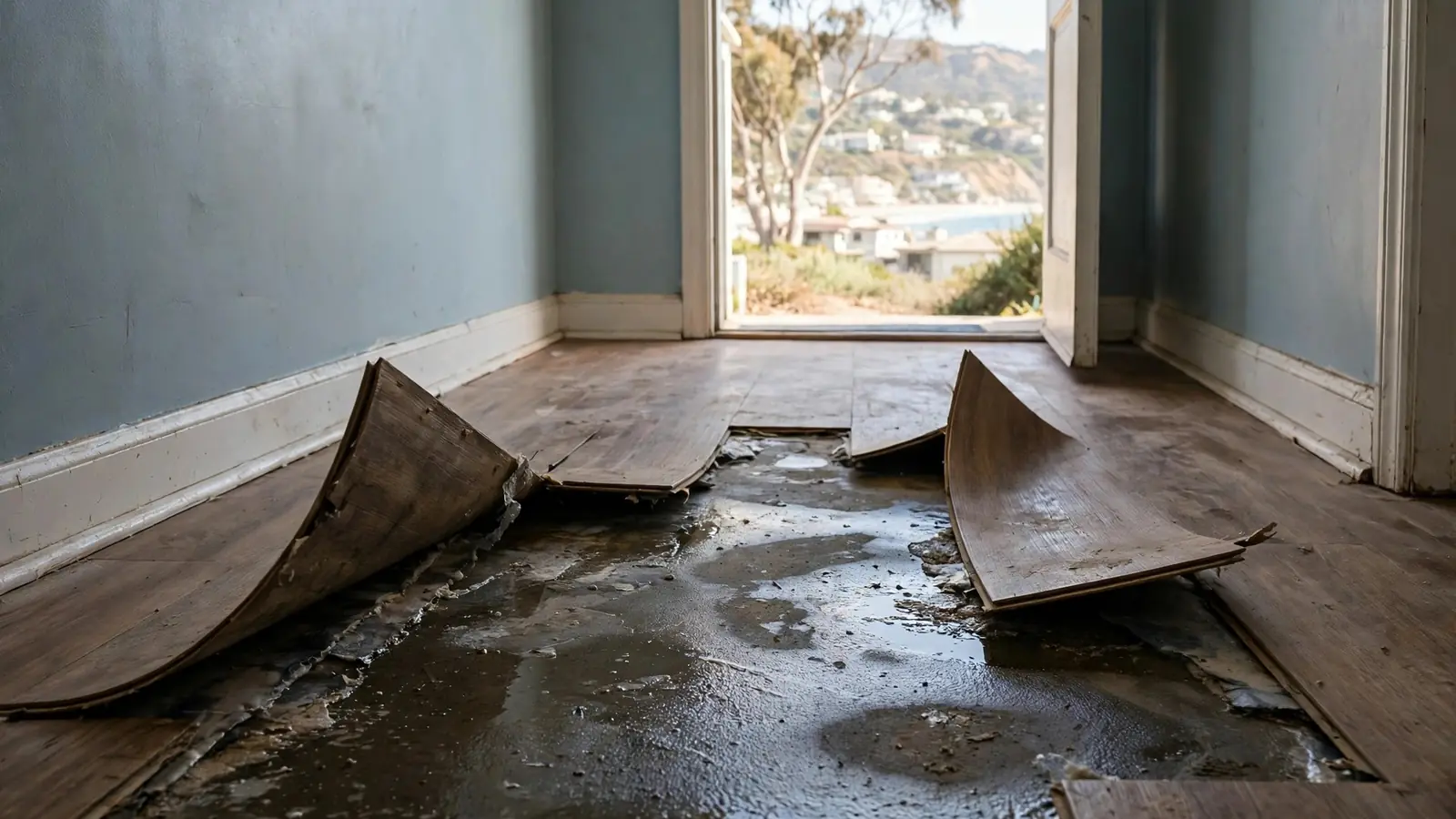
A slab leak is a leak in a water or drain pipe that runs under or inside the concrete foundation. In the ranch homes of Del Mar Heights, it usually involves a copper supply line, often the hot water line, which expands and contracts every time hot water runs. Over years, that movement wears the pipe against concrete or gravel until a pinhole opens.
The signs are easy to miss at first: a warm spot on a tile floor, the sound of running water when nothing is on, a water bill that rises for no reason, or a damp patch in carpet that never quite dries. Later, flooring lifts, baseboards swell and mold appears along the base of walls.
Fixing a slab leak is two jobs. A leak detection plumber finds the pipe, often with acoustic or thermal equipment, and either repairs it through the slab or reroutes the line through the walls or attic. A restoration contractor then dries the flooring, slab and walls. Rerouting is common in older homes because one slab leak often means more to come.
Drying a slab after a leak takes time. Flooring over the wet area usually has to come up, and the slab is dried with dehumidifiers and air movers until readings reach the dry goal. New flooring should not go down until then.
Assessment
What a contractor should check in a Del Mar Heights home
- 1
Confirm the leak is stopped
A slab leak may need the main shut off until the plumber reroutes or repairs the line.
- 2
Map moisture across the slab
Readings across every room near the leak show how far water has spread under the flooring.
- 3
Check walls on both sides of the leak
Water under the slab wicks into the bottom of drywall and the bottom plate on nearby walls.
- 4
Identify the flooring
Glued-down vinyl, tile, laminate and carpet each need a different approach to reach the slab.
- 5
Test older materials
Vinyl flooring, mastic, joint compound and textured ceilings in homes of this age may contain asbestos, and paint may contain lead. [6]
- 6
Coordinate with the plumber
Drying ends only after the leak is repaired and the line pressure tested.
What you might see
Del Mar Heights water damage clues and causes
| What you notice | Likely cause | What to do |
|---|---|---|
| Warm spot on a tile floor | Hot water slab leak | Leak detection; repair or reroute; dry slab |
| Water bill rising with no change in use | Hidden leak under the slab or in the yard | Check the meter with all water off; call a plumber |
| Rust-colored water from a faucet | Corroding galvanized pipe | Plan to replace galvanized sections |
| Small wet spot on a ceiling or wall | Pinhole leak in copper | Repair the pipe; dry the cavity |
| Sewer smell in a bathroom | Cracked cast-iron drain under the slab | Camera inspection; repair; dry and disinfect |
| Water in the garage around the heater | Failing water heater tank | Shut off supply; replace heater; dry garage and adjoining walls |
Water heaters
Water heaters in Del Mar Heights garages
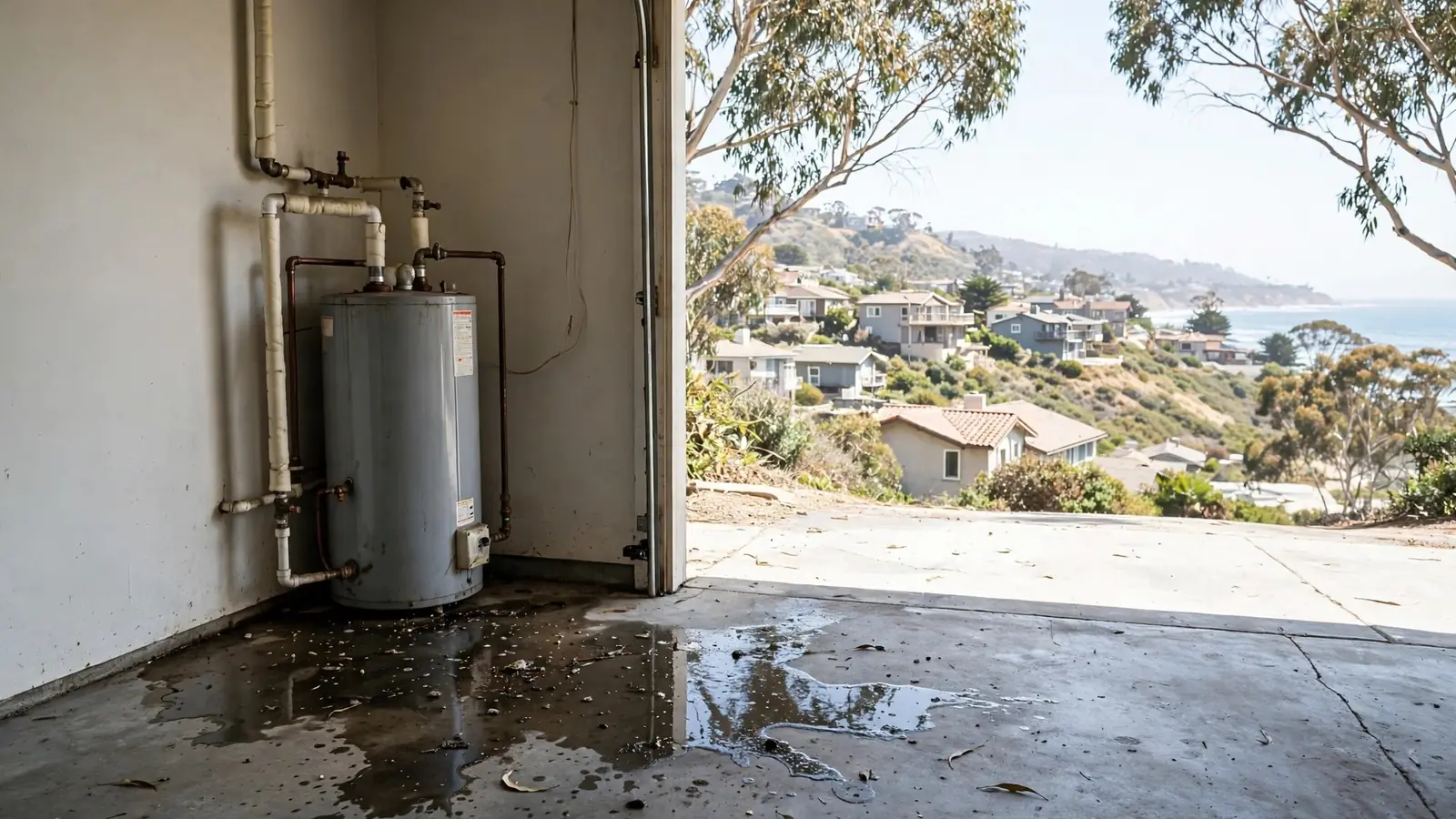
In many Del Mar Heights homes, the water heater sits in the attached garage, often on a platform against the wall shared with the house. When a tank finally fails, it can release its full volume and keep refilling from the supply until someone closes the valve.
That water floods the garage slab and often runs under the shared wall into a laundry room, hallway or bedroom. The garage side is usually simple to clean and dry; the house side may need baseboards removed, drywall dried or cut, and flooring lifted.
Knowing where the cold supply valve is on top of the heater, and closing it quickly, limits the damage. A drain pan with a line to the outside and a leak sensor are worth adding when the heater is replaced.
- Close the cold supply valve on top of the heater
- Check the shared wall on the house side
- Add a pan and leak sensor on replacement
Remodel surprises
Leaks found during remodels
A lot of Del Mar Heights homes are being remodeled, and remodels often uncover water damage that has been building for years: rotted subfloor under an old shower, mold behind a kitchen sink cabinet, a slow drain leak that soaked the soil under a bathroom. Remodels also create new risks, with temporary plumbing, open walls and exposed floors during a storm.
If your contractor finds water damage during a remodel, stop and document it before it is covered up. A restoration contractor can measure moisture, dry what needs drying and remove what is too far gone. Some insurers will consider a claim for hidden damage found this way, depending on the policy and how long the leak ran.
Drying
Drying ranch homes on slabs
Single-story homes on slabs have a simple shape but a slow-drying base. The slab under a wet area can hold water for a long time, especially if it was covered by vinyl or laminate that trapped the water. Contractors lift the flooring over the wet zone, run dehumidifiers and air movers across the exposed slab, and dry the bottom of nearby walls through holes behind the baseboards.
Del Mar Heights sits higher than the beach but close enough to the ocean that the marine layer often reaches it. Closed-house drying with dehumidifiers is usually the most efficient. Readings decide when it is done; for a slab, that may be longer than for the walls above it.
Rebuild
Permits and rebuilding in Del Mar Heights
Because Del Mar Heights is part of the City of San Diego, plumbing reroutes, water heater replacements and many rebuild jobs go through the City of San Diego's permit process rather than the City of Del Mar's. Your plumber and rebuild contractor should know which permits apply.
If you are rebuilding after a slab leak, it is a good time to consider a full repipe or reroute of the old supply lines, replacing galvanized sections, and adding leak sensors. If the floors are being replaced anyway, tile or other water-tolerant flooring in kitchens, baths and laundry areas holds up better to future leaks.
Insurance
Insurance for Del Mar Heights water damage
Homeowners policies often cover sudden water damage from inside the house, such as a burst pipe or a failed water heater, but treat the plumbing repair itself and long-term leaks differently. Slab leaks are a common point of confusion: the policy may cover access to the pipe and the resulting water damage, but not the pipe repair, or it may exclude damage from a leak that ran a long time. Read your policy and ask your agent.
Good records help. Keep the plumber's leak detection report, the contractor's moisture map and drying log, and photos before and after flooring is removed. The California Department of Insurance has consumer guidance if a claim stalls. [5]
Prevention
Lowering the risk in an older Del Mar Heights home
- 1
Check your meter for hidden leaks
Turn off all water and watch the meter. If it moves, there is a leak somewhere.
- 2
Plan for old pipes
Ask a plumber about the condition of copper and galvanized lines and whether a repipe or reroute makes sense.
- 3
Replace supply hoses
Toilet, faucet and washer hoses should be replaced every several years.
- 4
Service the water heater
Have it checked and add a pan, drain line and sensor.
- 5
Camera-inspect old drains
A cast-iron drain under the slab can be checked before it fails.
Related problems
Problems that follow water damage in Del Mar Heights
Repeat slab leaks
One pinhole leak in old copper often means more. Rerouting avoids chasing them one by one.
Mold behind baseboards
Water from slab leaks wicks into the base of walls where mold grows unseen.
Flooring failure
Laminate and engineered wood over a damp slab cup, swell or lose adhesion.
Lead and asbestos disturbance
Demolition without testing in older homes can spread hazardous dust.
Split-levels
Split-level homes on the canyon edges
Not every Del Mar Heights home is a flat single story. On the streets near the canyon edges, split-level designs step down the slope, with a garage or family room half a level below the main floor. Those lower rooms collect water from inside the house, because they are the lowest point, and sometimes from outside when heavy rain runs toward the house.
A leak on the upper half of a split-level often shows up on the lower half: water runs down through the short stairway, along joists and into the ceiling or walls of the room below. Drying has to follow it, and the contractor should take readings on both levels even if only one looks wet.
Roofs
Low-slope roofs and older roofing
Many original ranch homes in the neighborhood have low-pitched roofs, some with gravel or rolled roofing on the flattest sections and wide overhangs. Low slopes drain slowly, and older roofing on them can fail at seams and around vents. In a winter storm, water can pond and find a way into the attic, where it soaks insulation and comes through the ceiling at a light fixture or seam.
If you see a ceiling stain after rain, the attic insulation above it is probably wet. Restoration means removing the wet insulation, drying the ceiling drywall or replacing it if it sagged, and drying the framing, after the roof is repaired. When you reroof, ask about better underlayment and flashing on the low-slope sections.
Outside the house
Irrigation and yard lines
Lawns and planting beds are common on Del Mar Heights lots, and the irrigation lines and valves that feed them are often old too. A broken line near the house can saturate the soil against the foundation and, on some homes, push water under the slab edge or into a garage. A valve manifold that fails next to a wall can do the same.
If a wall near a planter bed stays damp, or a garage floor is wet along one edge, check the irrigation before assuming a plumbing leak inside. The meter test helps: turn off the irrigation controller and all indoor water and see whether the meter still moves.
On the call
What to tell the contractor about your Del Mar Heights home
The year the house was built
It tells the contractor what plumbing and materials to expect and whether testing is needed.
The flooring in the wet rooms
Tile, glued vinyl, laminate or carpet each change how the slab is reached and dried.
What the plumber found
If a leak detection report exists, share it. It shows where the pipe failed and how far water spread.
Whether a remodel is under way
Open walls and temporary plumbing change the plan and the access.
Any earlier leaks
Previous slab leaks or repairs often point to the same section of pipe.
Near the reserve
Homes near Torrey Pines and the reserve edge
The southern streets of Del Mar Heights run toward Torrey Pines State Natural Reserve, with its sandstone bluffs and protected native pines. Lots at the edge of open space can have slopes behind them that send runoff toward the house in heavy rain. Gutters and drains on those homes should discharge away from the foundation and toward approved drainage, and side yards should not slope back toward walls. A wet garage or a damp back bedroom after storms is often the first sign that the grading needs attention.
FAQ
Del Mar Heights water damage questions
Does this line cover Del Mar Heights?
Yes. Calls from Del Mar Heights homes in ZIP 92014 can be connected to an independent restoration contractor.
Is Del Mar Heights part of the City of Del Mar?
No. It is a neighborhood of the City of San Diego that shares the 92014 ZIP code. Permits go through San Diego.
How do I know if I have a slab leak?
Warm spots on the floor, the sound of running water, a rising water bill or damp flooring with no obvious source are common signs. A leak detection plumber can confirm it.
Can the slab be dried without breaking it up?
Yes. The slab itself is dried in place once the flooring over the wet area is lifted. Only the spot where the plumber repairs the pipe is opened.
Should I repair or reroute a slab leak?
That is a plumbing decision. In older homes, many plumbers recommend rerouting because the remaining pipe is the same age.
Is my house old enough to have asbestos or lead?
Homes built before about 1980 may have asbestos in some materials, and homes built before 1978 may have lead paint. Testing is the only way to know.
Will insurance pay for a slab leak?
Often for the resulting water damage and access, not always for the pipe itself, and not for long-term leaks. Check your policy.
Can I stay in the house during slab drying?
Usually yes. Equipment runs around the clock in the affected rooms, and those rooms may be off limits for a few days.
How long does slab drying take?
Several days to a couple of weeks, depending on how long the leak ran and what flooring covered it.
Sources and citations
- [1]Wikipedia: Del Mar Heights, San Diego
- [2]California State Parks: Torrey Pines State Natural Reserve
- [3]IICRC S500 Standard for Professional Water Damage Restoration
- [4]EPA: A brief guide to mold, moisture and your home
- [5]California Department of Insurance
- [6]EPA: Protect your family from exposures to asbestos
- [7]EPA: Renovation, Repair and Painting Program
- [8]Contractors State License Board (CSLB)