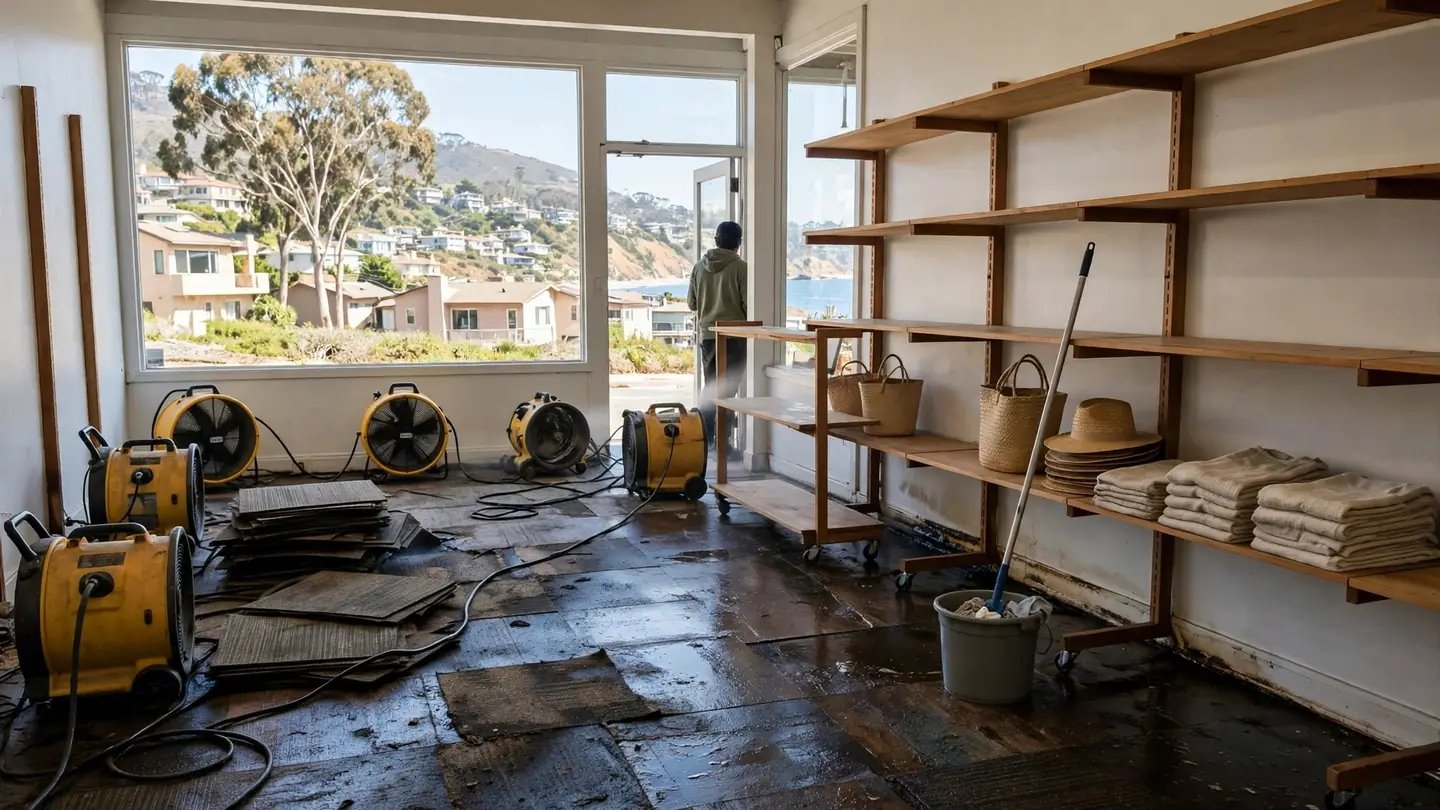
Key facts: Commercial Water Damage
- Commercial losses often involve several parties: owner, tenants, property manager, HOA and more than one insurer.
- Water from fire sprinkler lines is usually stagnant and treated as at least Category 2 under the IICRC S500 approach.
- Restaurant drain and grease line backups are treated as Category 3 sewage.
- Del Mar Village along Camino del Mar mixes retail, restaurants, offices and residential units, often in shared buildings.
How it works
How commercial water damage differs
The drying science is the same in a shop as in a house: remove the water, take out what cannot be saved, dry the rest and measure until it is done. What changes is everything around it. A business loses revenue every hour it is closed. Customers and staff have to be kept safe. Several people have a say in decisions, and each may have their own insurer. Records matter even more, because the claims are larger and more parties review them.
Commercial restoration also tends to involve bigger spaces and different materials. Commercial carpet tile, glued-down flooring, suspended ceilings, steel stud walls, open-plan offices, commercial kitchens and stacked condo units each dry differently. Equipment is often larger and more numerous, and the contractor may need to work in phases so parts of the building stay open.
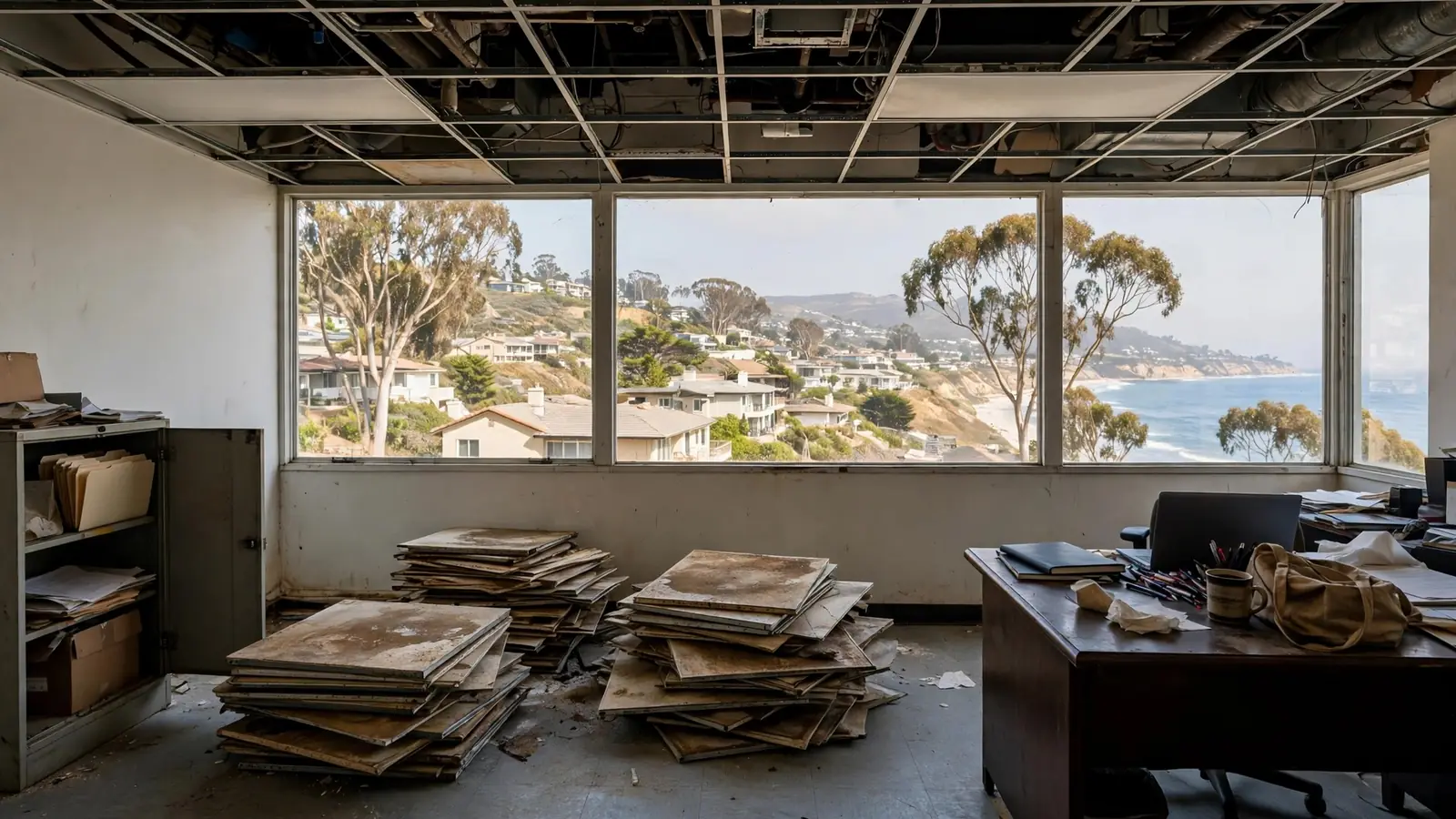
In Del Mar, most commercial buildings are small to mid-sized: storefronts and restaurants along Camino del Mar in the village, offices, hotels and inns near the beach, condo and townhome complexes on the hills, and the event buildings and stables associated with the Del Mar Fairgrounds. That mix shapes how a commercial loss is handled here.
The common thread is speed with coordination. The contractor needs to know quickly who can authorise work, which areas must stay open and where the water started, so they can protect the building without stepping on anyone's responsibilities.
Common causes
Commercial water damage sources
Fire sprinkler leaks and discharges
A broken sprinkler head or a frozen or corroded line releases stagnant water under pressure. The water is dirty, and the flow is high until the system is shut down.
Restaurant drain and grease backups
Grease builds up in kitchen lines and grease interceptors. When a line blocks, waste water backs up through floor drains into kitchens and dining rooms.
Roof and flat-roof leaks
Many commercial buildings have low-slope roofs that pond water. Winter storms find failed seams and flashing, and water travels along the deck before it drips.
HVAC condensate and cooling towers
Clogged condensate lines and failed drain pans overflow into ceilings. Rooftop units can leak into the space below.
Shared plumbing stacks
In multi-unit buildings, a blocked or broken stack can affect units above or below the source. Responsibility depends on the governing documents.
Storm runoff and street flooding
Ground-floor shops on low streets can take water through doors during heavy rain or when storm drains back up.
Local context
Del Mar's commercial buildings
The village along Camino del Mar is the heart of Del Mar's commercial life: restaurants, cafes, galleries, boutiques, salons, real estate offices and small hotels, many in two- and three-story buildings with apartments or offices above shops. A leak in an upstairs unit can come through the ceiling of the business below, and a backup in a shared sewer line can affect several tenants at once.
North of the village, the Del Mar Fairgrounds hosts the San Diego County Fair, horse racing and year-round events. The fairgrounds sit on low ground near the San Dieguito River, and city studies of sea level rise note that river flooding is expected to reach the fairgrounds area more often in the future. Businesses in that low-lying district face the same flood concerns as homes nearby.
On the hills and in Del Mar Heights, commercial work more often means condo and townhome communities, where an HOA owns common elements and each owner has their own unit. Those losses mix residential and commercial issues: who repairs the shared wall, which insurer covers the ceiling below, and how to schedule work in occupied units.
The process
How a commercial water loss is handled
- 1
Stop the water and secure the building
Shut off the sprinkler zone, main or fixture; make electrical systems safe; set up signage and barriers to keep customers and staff out of wet areas.
- 2
Identify the decision makers
Confirm who owns the building, who manages it, which tenants are affected and who can authorise emergency work. Note the insurers involved.
- 3
Assess and map the loss
Moisture mapping across all affected units and floors, photos and video, and a list of affected equipment, stock and records.
- 4
Plan phased work
Decide which areas must stay open, which can close, and in what order work will move through the building. Set working hours if needed to avoid business hours.
- 5
Extract, remove and contain
Large-capacity extraction, removal of wet ceiling tiles, insulation, carpet and drywall, and containment to protect occupied areas.
- 6
Dry with commercial-scale equipment
Banks of dehumidifiers and air movers, sometimes with temporary power or ducted drying for large spaces. Readings are logged daily per area.
- 7
Document and hand over
Drying logs, photos and removal records per unit or area, so each party and insurer has what they need for the rebuild phase.
By building type
Commercial settings and their main concerns
| Setting | Main concerns | Typical approach |
|---|---|---|
| Restaurant or cafe | Health code, food safety, grease backups, quick reopening | Sewage protocol in kitchen; discard exposed food; work after hours |
| Retail shop | Stock damage, display fixtures, customer safety | Move or protect stock; phase work by section; document inventory |
| Office | Electronics, records, open-plan carpet tile | Protect equipment; lift carpet tiles; dry records separately |
| Hotel or inn | Guest rooms out of service, stacked plumbing | Close affected rooms only; contain work; dry stack walls |
| Condo or townhome building | Multiple owners, HOA rules, shared walls | Coordinate per unit; follow governing documents; separate logs |
| Event and agricultural buildings | Large open spaces, floods near the river | High-volume extraction; large dehumidification; silt removal |
Business continuity
Keeping the business open where possible
Few businesses can afford to close for a week, and in a small town every storefront that goes dark is noticed by regular customers. Commercial restoration plans work so that unaffected areas stay usable and affected areas return to service as early as possible.
That can mean setting up containment so a shop's front half stays open while the back dries, scheduling demolition at night, running quieter equipment during business hours, or moving stock and staff to another part of the building. In restaurants, health rules usually require the affected kitchen to close until it is cleaned and inspected, but a dining room might reopen sooner.
Ask the contractor early about the timeline for each area. It helps you plan staff, customers and conversations with your insurer about business interruption cover.
- Phased drying by area
- After-hours demolition when needed
- Containment to protect open spaces

Responsibility
Who handles what in a multi-tenant loss
| Party | Typical role |
|---|---|
| Building owner | Structure, roof, common plumbing, building insurance |
| Property manager | Coordination, access, vendor approval, tenant communication |
| Tenant | Stock, fixtures, equipment, improvements they installed, their own insurance |
| HOA (condos) | Common elements and shared systems as defined in the CC&Rs |
| Unit owner (condos) | Interior finishes and contents, as defined in the CC&Rs and their unit policy |
| Restoration contractor | Mitigation, drying, documentation; rebuild if engaged |
DIY or professional
When to bring in a commercial restoration contractor
Building maintenance staff and on-site managers can usually handle a small spill, a leaking fixture or a clogged drain. Once water has spread across a floor, into ceiling cavities, into a second unit or into a kitchen, a restoration contractor should be involved. Commercial spaces are larger, the materials are different, and the stakes are higher: a wet carpet tile floor in an office that is not dried properly can lead to mold and an indoor air complaint months later.
Documentation is a further reason. Commercial claims are reviewed closely, and several insurers may each want to see what happened in their part of the building. A contractor who keeps separate logs and photos per unit or tenant makes those claims much easier.
The visit
What the first commercial visit looks like
- 1
Call
You describe the building, the source, the affected areas and who is responsible. The contractor tells you what to do immediately.
- 2
Arrival and safety
Walkthrough with whoever has authority, safety checks and barricades.
- 3
Assessment
Moisture mapping across affected areas and units; photos and an inventory of affected equipment and stock.
- 4
Plan and authorisation
A phased plan with timelines per area, agreed with the decision makers.
- 5
Start of mitigation
Extraction, removals and drying setup, with daily monitoring and updates to each party.
Insurance
Insurance for commercial losses
Start with notice. Tell the building's insurer, and ask tenants to tell theirs, on the day the loss is found, even before the full extent is known. Late notice is one of the easiest ways for a commercial claim to become complicated, and most policies ask for it promptly. Then let the contractor's documentation do the work: it is far easier for an adjuster to approve emergency drying when the readings and photos are already in hand.
Commercial property policies, tenant policies and HOA master policies all work differently, and many businesses also carry business interruption cover for lost income while closed. Notify every relevant insurer promptly and keep a single, organized set of records: the cause, the timeline, photos before and after removal, moisture readings and drying logs, inventories of damaged stock and equipment, and receipts.
Flood damage from outside surface water, such as river or street flooding, is usually excluded from standard commercial property policies and needs separate flood insurance. Water from internal sources like sprinklers or plumbing is commonly covered, subject to the policy. The California Department of Insurance has guidance for business owners as well as homeowners. [6]
Prevention
Lowering the risk in your building
Schedule regular sprinkler inspections, keep heat in sprinkler-protected spaces, and replace corroded heads and lines. In restaurants, keep the grease interceptor on a cleaning schedule and train staff on what goes down drains. Check flat roofs and drains before the rainy season, and clear HVAC condensate lines.
In multi-unit buildings, leak sensors under sinks, behind toilets and near water heaters in each unit reduce the size of losses, and some HOAs now require them. Know where the shut-offs are for each unit and for the building, and keep that information where staff and residents can find it.
Related problems
Problems that follow commercial water damage
Mold in ceiling cavities
Insulation and ceiling tiles above a leak stay damp if they are not opened, and mold grows out of sight.
Indoor air complaints
Damp carpet tile and wall cavities can produce odors and complaints from staff or guests.
Electrical faults
Water in conduit, panels and equipment can cause outages and fire risk later.
Health code issues
Restaurants and food businesses may need re-inspection after a contamination event.
Food service
Restaurant kitchens after a backup
A drain backup in a commercial kitchen is a sewage event in a space that has to meet health rules. Floor drains, floor sinks and grease interceptor lines are usually where the water comes up, and it spreads under cooking lines, walk-in coolers and prep tables. Everything at floor level that it touched needs cleaning and disinfection, and food, packaging and single-use items in the affected area are thrown out.
The work sequence matters. A plumber or grease line service clears the blockage first. The restoration crew then extracts the water, pulls equipment away from walls where it can be moved safely, removes wet cove base and any wet wall materials, cleans and disinfects floors, walls and equipment surfaces, and dries the space. Some restaurants also need the county environmental health office to review the kitchen before it reopens. Ask your operator or manager what your permit requires.
Dining rooms often take less water and may be cleaned and reopened before the kitchen. Containment between the two keeps dust and odor out of the guest area.
Contents
Electronics, records and inventory
Offices and shops have contents that need different handling from household furniture. Computers, servers, point-of-sale terminals and phone systems that got wet should be unplugged and left off until an electronics specialist checks them; turning them on can short the boards. Paper records and files can often be saved if they are frozen quickly and then freeze-dried by a document recovery service.
Retail stock is usually photographed, counted and sorted on site: what is undamaged, what can be cleaned and what is lost. That inventory is the basis of the stock part of the claim, so it is worth doing carefully, ideally with the store manager present. Keep any damaged goods until the adjuster says they can be discarded.
Hospitality
Inns, hotels and short-term rentals
Hotels and inns near the beach, and the many short-term rentals in and around Del Mar, face a particular kind of water loss: plumbing stacked floor above floor, guests who may not report a leak right away, and rooms that are booked for the next night. A leaking toilet supply in one room can affect the room below and the corridor between them.
Restoration in hospitality settings aims to take as few rooms out of service as possible. The contractor contains the affected rooms, dries shared walls from the corridor side where possible, and works around guest schedules. For short-term rental owners, quick documentation of the loss and the cancelled stays helps with both property and loss-of-income claims, if your policy includes that cover.
Scale
Drying large open spaces
Large open areas such as event halls, warehouses, gyms and open-plan offices hold a lot of air, and drying them with portable units alone can be slow. Contractors may use trailer-mounted desiccant dehumidifiers with ducting that delivers dry air directly onto the wet floor, or build temporary containment to shrink the volume they have to treat. Power is a further consideration: a large job may need temporary power so the building's circuits are not overloaded. The contractor should plan this on the first visit.
Before you call
What to have ready when you call about a commercial loss
Where the water started
The source, when it was noticed and whether it has stopped. For sprinklers, which zone was shut off.
Who is in charge
The owner, property manager or HOA contact who can approve emergency work, and how to reach them.
Which areas are affected
Floors, suites, units or rooms, and whether any are occupied or open to the public right now.
Access and hours
How the contractor gets in, alarm codes held by staff, parking and loading, and any hours when work is not allowed.
Insurance details
The building's insurer and, if known, tenants' insurers. The claim numbers can follow, but early notice helps.
FAQ
Commercial water damage questions in Del Mar
Can my business stay open during restoration?
Often partly. Contractors can contain the affected area and phase the work so other areas stay open. Restaurants may need to close the kitchen until it is cleaned.
Who should call the contractor in a rented space?
Whoever discovers the water should start the emergency response, then inform the property manager and owner. Leases usually set who authorises and pays for the work.
Is sprinkler water clean?
No. Water that sits in sprinkler lines for years is stagnant and often dark and smelly. It is treated as contaminated.
How are condo leaks between units handled?
Each unit is assessed and documented separately. The HOA's governing documents decide who is responsible for shared elements and which insurer handles each part.
Can work happen after hours?
Many contractors can schedule noisy work and demolition outside business hours. Ask during the call.
What about damaged stock?
Document it with photos and an inventory before disposal. Some items can be cleaned; food and single-use goods that water touched are usually discarded.
Is street flooding covered by my business insurance?
Usually not under a standard commercial property policy. Flood cover is separate. Check with your agent.
Do you handle water damage at event venues?
Yes. Calls about event and exhibition spaces are connected to an independent contractor who can bring large-capacity extraction and drying equipment.
How long does commercial drying take?
Similar to homes for small spaces, three to five days, but larger and phased jobs take longer. Daily readings show progress per area.
Sources and citations
- [1]IICRC S500 Standard for Professional Water Damage Restoration
- [2]EPA: A brief guide to mold, moisture and your home
- [3]Coastal Commission: City of Del Mar Local Coastal Program sea level rise grant application
- [4]Wikipedia: Del Mar Fairgrounds
- [5]California Coastal Commission: San Diego region sea level rise vulnerability
- [6]California Department of Insurance
- [7]OSHA: Flood preparedness and response
- [8]Contractors State License Board (CSLB)